Code-aware discovery
Scans source code, web surfaces, OpenAPI/schema files, Kubernetes/IaC signals, notices, and consent traces to find privacy-relevant evidence.
Open source privacy engineering for India
A local-first PrivacyOps workbench that scans code, websites, notices, cloud and security signals, vendors, and consent surfaces, then turns them into actions teams can review before a release.
Why it exists
Most compliance work becomes a tracker of manual statements: policy exists, screenshot attached, owner says done. Svikruti takes a different approach. It starts from the systems that actually process data, then creates a trace from source evidence to privacy obligation, control posture, and remediation.
The goal is not to replace legal review. The goal is to give privacy, security, product, and engineering teams a shared evidence layer they can inspect, challenge, and improve.
Scans source code, web surfaces, OpenAPI/schema files, Kubernetes/IaC signals, notices, and consent traces to find privacy-relevant evidence.
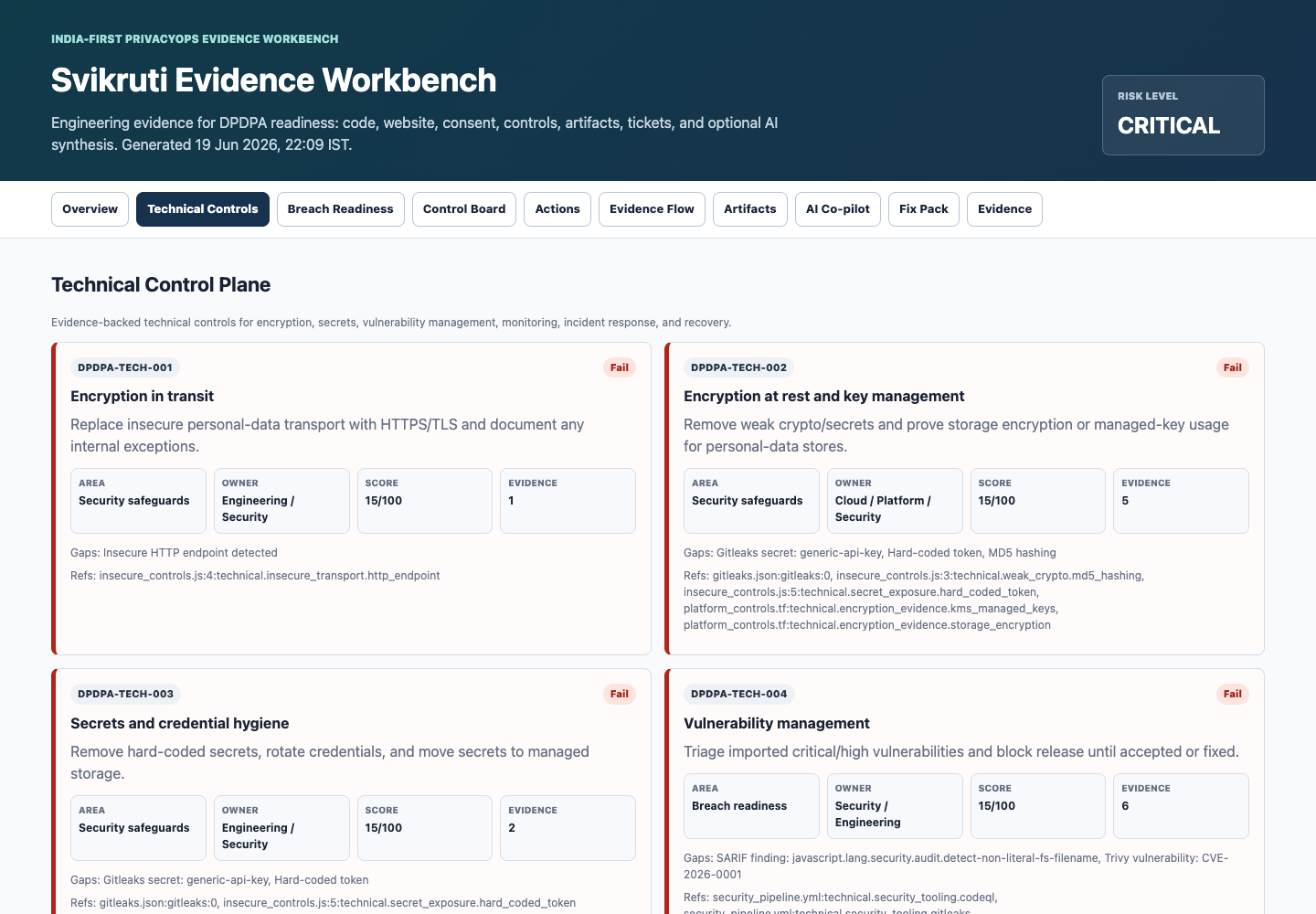
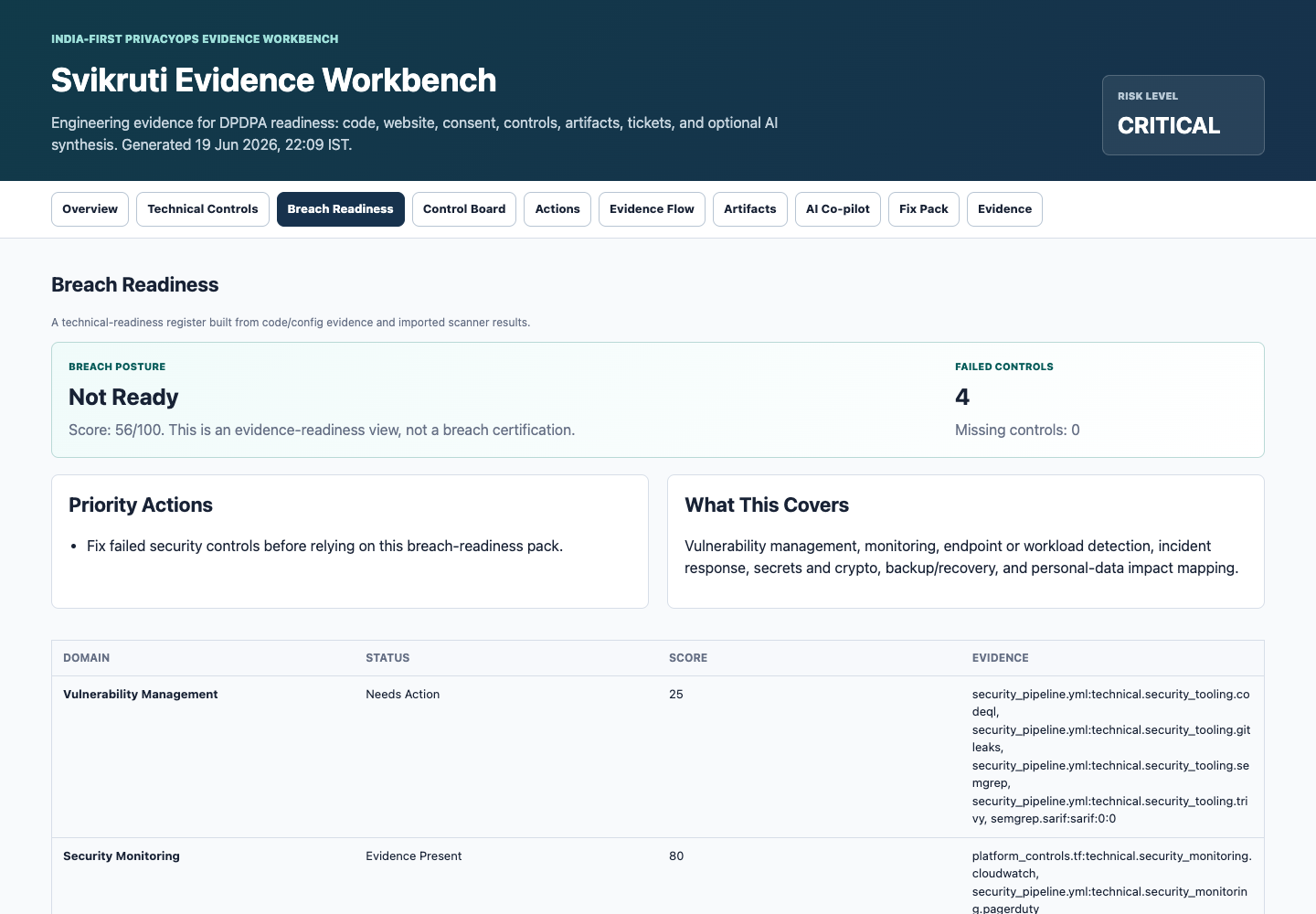
Connects DPDPA readiness to encryption, secret hygiene, logging risk, vulnerability management, monitoring, backup, and incident response evidence.
Produces structured evidence packets that an AI reviewer can summarize without inventing facts outside the scanner results.
Runs on your machine by default. Teams can inspect results without sending repositories or sensitive evidence to a hosted scanner.
Workflow
Repository, website, notice, consent path, schema, cloud and security evidence.
Connect personal-data categories to source files, systems, vendors, and notice coverage.
Score technical controls such as encryption, monitoring, secrets, vulnerability management, and incident readiness.
Convert high-risk evidence into release decisions, owners, priorities, and acceptance criteria.
Generate artifacts for humans, CI, GRC workflows, procurement, legal review, and AI synthesis.
Product surface
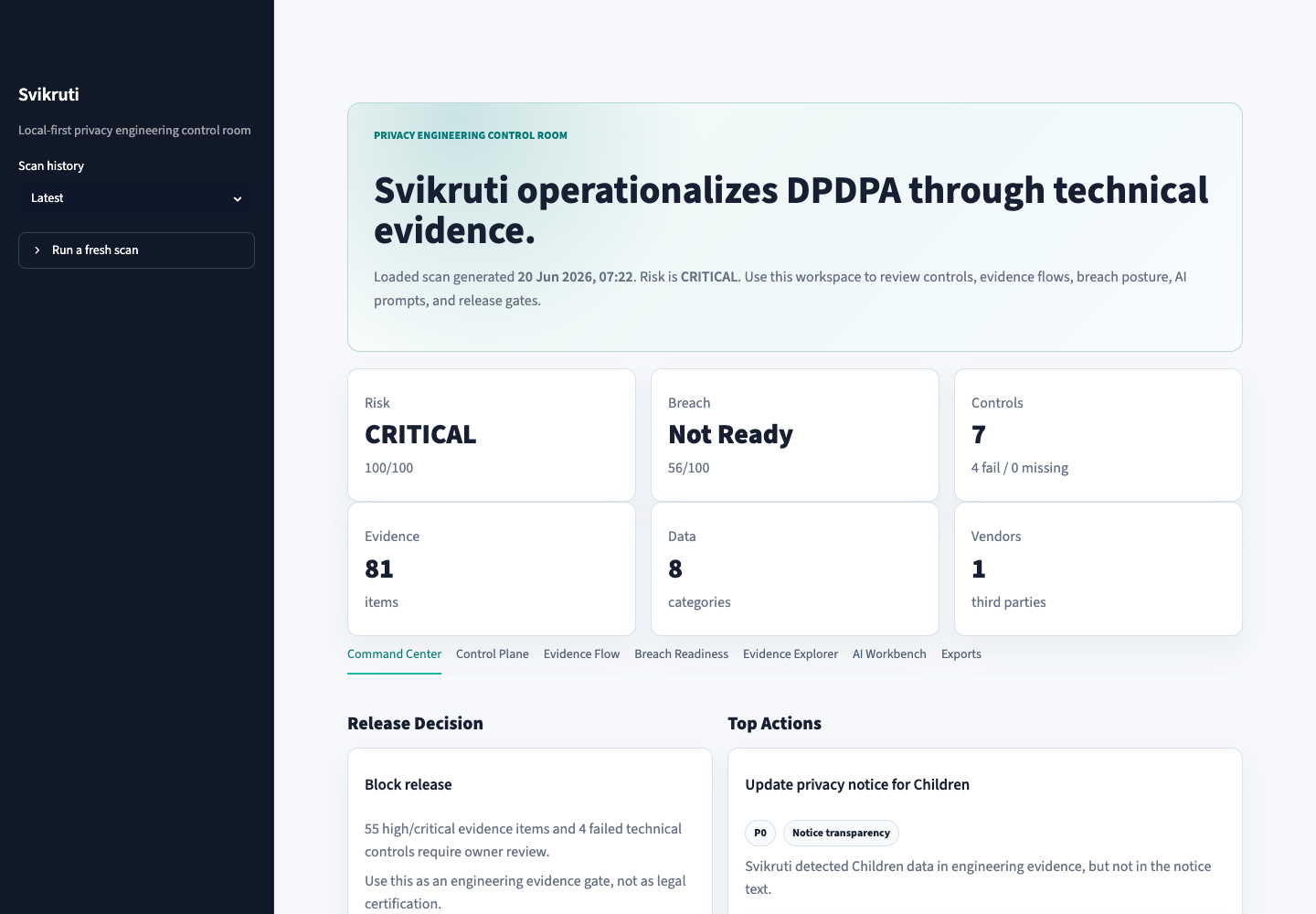
Use the local dashboard during release review, audit preparation, vendor checks, or breach readiness conversations. It is designed to show what was found, what is weak, what needs an owner, and which artifacts can be exported.
Launch artifact pack
A review cockpit for risk, control posture, breach readiness, evidence search, and AI-ready summaries.
A portable report for privacy, security, legal, product, and engineering review without uploading code.
GitHub code scanning output so privacy and security findings can show up in pull-request workflows.
A starter processing inventory with data categories, purposes, owners, systems, vendors, and evidence references.
Third-party and processor register starter with DPA, transfer, safeguards, review, and ownership fields.
Copy-ready issue bodies for GitHub, Jira, or Linear with priority, owner hints, acceptance criteria, and evidence links.
Quickstart
Start with the realistic example pack, then point the scanner at your own repository. The open-source flow keeps the scan local and generates review artifacts you can share intentionally.
git clone https://github.com/chevauxenbois/svikruti
cd svikruti
python3 -m venv .venv
source .venv/bin/activate
python -m pip install -e .
svikruti scan --repo examples/realistic --save-history
svikruti dashboard
Open source now
The community version is meant to stay useful on its own: local scans, dashboard, evidence packs, export formats, and CI-friendly outputs.
Enterprise direction
Hosted evidence vault, scan history, org dashboards, SSO/RBAC, approvals, Jira/Linear/GRC integrations, and domain packs for BFSI, healthcare, ecommerce, SaaS, and fintech teams.
Build in public
Svikruti is my attempt to make DPDPA readiness more practical for India's privacy community: less theatre, more evidence, more open-source tooling.