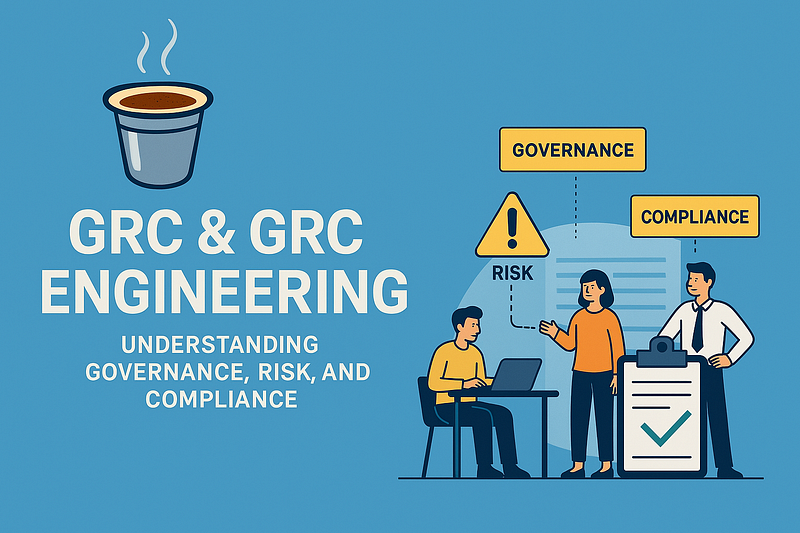
Imagine you're fed up with corporate and you start a filter coffee stand in Namma Bengaluru. In most non-technical fashion: you buy coffee, milk, and more (that's procurement), set prices or coffee/milk ratio for every cup of coffee (that's governance), keep an eye on rainy days (that's risk because you're stall is in an open area), and make sure your friend doesn't water down the coffee to cheat customers (that's compliance).
Congratulations, you're already doing GRC!
I was discussing something with an auditor when he shared a line. That line stuck with me because it's painfully true. :
"In the cloud, risk moves at the speed of a 'git commit,' not a committee meeting."
Because if your risk strategy isn't automated, it's already outdated. GRC is the autopilot for the digital enterprise.
The Basics: What Does GRC Mean?
GRC stands for Governance, Risk, and Compliance: the three pillars that prevent organizations from becoming chaotic entities.
- Governance: As simple as the rules: who decides what, and how.
- Risk Management: Spotting and preparing for what could go wrong (before it actually does).
- Compliance: Following laws, regulations, and internal policies—because orange jumpsuits aren't a good business uniform (at least as per "business standards").
Before jumping into more details, it's important for us to understand a bit of history.
When was "GRC" coined?
The concept existed long before the acronym. Back in the mainframe era (1970s–1980s), companies already had:
- Security committees (governance),
- Risk registers (on paper!), and
- Audit checklists (compliance).
The term "GRC" itself, however, was coined around 2002 by the Open Compliance and Ethics Group (OCEG) in response to corporate scandals and a growing focus on IT governance and data protection. When cybersecurity became a business risk (not just an IT issue), Information Security GRC emerged as a discipline on its own.
The Evolution of Information Security GRC
1. The Prehistoric Era: "Just Keep the Hackers Out" (1980s–1990s)
- Security = firewalls + antivirus.
- Audits were paper checklists.
- Policies were stored in dusty binders that nobody read.
2. The Compliance Boom (2000s)
- Regulations like SOX, PCI DSS, and HIPAA made companies formalize InfoSec controls.
- Spreadsheets ruled the land. GRC became synonymous with "audit prep season."
3. The Risk-Aware Era (2010s)
- Companies realized security ≠ checklists.
- They started linking GRC to business risk, asking, "If this system goes down, what's the real impact?"
4. The Modern Era: GRC Engineering (2020s–today)
With the latest developments, such as AI, GRC has become increasingly important and is one of the driving forces behind business decisions. Hence, GRC engineering comes into play (which we will explore in subsequent points).
Why GRC Has Always Been Part of InfoSec
Even before acronyms existed, humans governed information.
- Kings sealed letters with wax (data integrity).
- Couriers had clearance levels (access control).
- Libraries restricted scrolls (information classification).
GRC isn't new; it just got digital.
Today, GRC frameworks enable organizations to handle data responsibly, demonstrate continuous compliance, and establish trust with customers and regulators alike.
The New Imperative: GRC Engineering
This is the most important shift. GRC is no longer a non-technical field, even though many auditors today still approach cloud systems without a thorough understanding of how software actually works.
Old Way: Remind developers not to store passwords in plain text, then manually check their code six months later.New Way (GRC Engineering): The CI/CD pipeline automatically blocks code that violates the rule and generates an audit log instantly.
GRC Engineering is a fusion of automation, DevSecOps, and continuous assurance. It treats compliance and risk logic like any other software feature: built, tested, and deployed.
Technical Humans are Inevitable
The idea of GRC as a purely "policy and paperwork" job is dead (in tech companies at least). Why? Because the modern infrastructure (Cloud, Kubernetes, Serverless) is defined by code. If you cannot read, understand, or automate the security controls in that code, you cannot govern it.
If your policy says, "All cloud storage must be encrypted," a non-technical auditor checks a box. A GRC Engineer writes a script that runs every 5 minutes and automatically enables encryption for any newly created storage bucket that lacks it, or simply checks if it already exists.
In the modern era, Non-technical GRC is not GRC; it's auditing. True GRC is the continuous function of embedding control, which requires technical expertise.
The Invisible Architect: What GRC Actually Does Behind the Screens
GRC is often ignored because its success is silent. You never hear about the breach that didn't happen.
GRC's job is to be the invisible architect of business trust:
- Translating Legal Jargon to Code: GRC takes an opaque, 500-page regulation (like GDPR or RBI's rules) and breaks it down into a list of 50 technical controls (e.g., "Encrypt data at rest," "Limit access to 10 users"). You'll say How is that a big deal? Anyone can do it. However, GRC actually understands the entire landscape: engineering, products, vendors, SecOps, sales, CS, and implements controls accordingly: only what is necessary and relevant.
- Harmonizing the Chaos: GRC makes sure that securing your AWS cloud also helps you meet ISO 27001 requirements and SOC 2 requirements simultaneously. It removes the painful, siloed checklist work.
- Revenue Enablement: You cannot lie to a customer, saying you don't have DLP (Data Loss Prevention) software. In the SaaS world, successfully completing a Security Questionnaire is often the first step in closing a multi-million-dollar deal. GRC doesn't just save you from fines; it directly enables revenue. Sometimes, it takes a significant effort to explain to a customer that their data is actually safe with you. That's what GRC does: actually ensuring that the data is safe and gaining customer trust.
GRC is the New Black: The Startup Boom
The automation inherent in GRC Engineering is why the space is currently experiencing rapid growth in the startup world.
Venture Capital firms, including accelerator giants like Y Combinator (YC), are heavily backing "RegTech" (Regulatory Technology) and GRC automation startups. The focus is straightforward: manual GRC is slow, expensive, and prone to errors.
Even major AI players like Anthropic have their own intensive GRC needs, their entire business hinges on Responsible AI Governance and demonstrating model safety and security, proving that GRC sits at the cutting edge of frontier technology.
Compliance is no longer a cost center; it's a product feature that startups can deliver at lightning speed using engineering principles.
How to Start Your GRC Journey
GRC is still evolving, and everyone understands it differently—largely depending on whether they approach it from an Audit, IT, or Legal background. To gain a foundational, integrated understanding, I suggest consulting a few key documents. I am not a big fan of YouTube videos/courses when you are starting with something new and want to learn the foundations of it.
- OCEG GRC Capability Model (The Red Book) : This is the definitive, foundational material. OCEG coined the term GRC and provides the integrated framework showing how Governance, Risk, and Compliance must work together.
- NIST Special Publication 800–37 (Risk Management Framework) : While US government-centric, the NIST RMF provides a robust, technical, and repeatable process for managing security risk, which forms the bedrock of InfoSec GRC programs globally.
- ISO 27001 / SOC 2 : Don't read these cover-to-cover, but understand their structure. They represent the "Compliance" piece—the actual rulesets (controls) that GRC teams implement.
- Governance, Risk, and Compliance Handbook (Book)—An excellent, often massive, technical resource that covers GRC across various domains (Technology, Finance, etc.).
The journey starts by moving beyond the checklist and asking the fundamental question: "How can I use technology to prove, continuously and automatically, that we are reliably achieving our objectives?"